
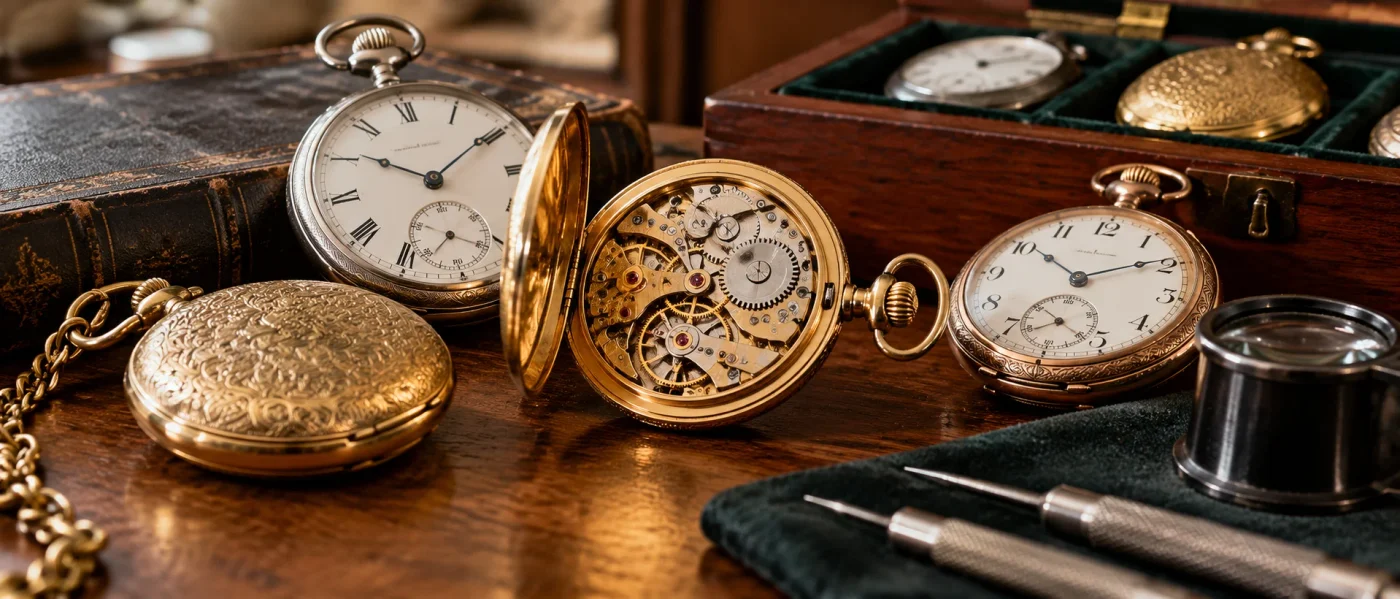
Found an old pocket watch in a drawer, inherited one from a relative, or simply wondered whether the watch you own could actually be valuable? ⌚ The short answer is yes, pocket watches can still be worth money today, but age alone does not make a watch valuable.
Two watches that appear almost identical from the outside can have dramatically different values. One might be a relatively common mass-produced piece, while another could contain a desirable mechanical movement, a solid gold case, an unusual complication or the signature of an important watchmaker. In other words, asking “Are pocket watches worth anything?” is only the beginning. The more useful question is: what makes a particular pocket watch valuable?
In this guide, we will examine the clues that matter most: maker, movement, hallmarks, precious metals, age, rarity, condition, originality and provenance. We will also explain how to inspect an old pocket watch without accidentally damaging it, why some apparently luxurious watches are worth surprisingly little, and why an understated example can sometimes be far more interesting to collectors.
🔎 Quick answer: Pocket watches can be worth anything from a modest amount for common examples to hundreds or even thousands of pounds for desirable antique pieces. Exceptional watches from prestigious makers, complicated movements and rare precious-metal examples can reach considerably higher values. The determining factors are maker, movement quality, case material, rarity, originality, condition and provenance.
Are old pocket watches actually worth money?
Yes, many old pocket watches are worth money, although their values vary enormously. The market includes everything from relatively inexpensive vintage watches purchased primarily for decoration or everyday wear to historically important mechanical pieces sought by serious collectors.
The important distinction is that “old” and “valuable” are not synonyms. Pocket watches were produced in huge quantities, particularly during the nineteenth and early twentieth centuries. Manufacturers such as Waltham and Elgin produced enormous numbers of watches, meaning that age by itself does not automatically create scarcity.
A common watch with a basic movement, worn dial and base-metal case might therefore remain relatively affordable even after more than a century. Conversely, a watch of similar age containing a high-grade movement, desirable complication or solid precious-metal case can occupy an entirely different part of the market.
This is why experienced collectors rarely judge a pocket watch solely from its dial or external appearance. They want to know what is inside the case, who made it, what grade the movement is, whether the components are original and what the case is actually made from.
“The most attractive-looking pocket watch is not necessarily the most valuable. In mechanical watch collecting, much of the important information is hidden inside the case.”
That principle is worth remembering if you have inherited a watch. Do not dismiss a scratched or slightly tarnished example simply because it looks old. Equally, do not assume that a shiny gold-coloured watch must contain a fortune.
What makes a pocket watch valuable?
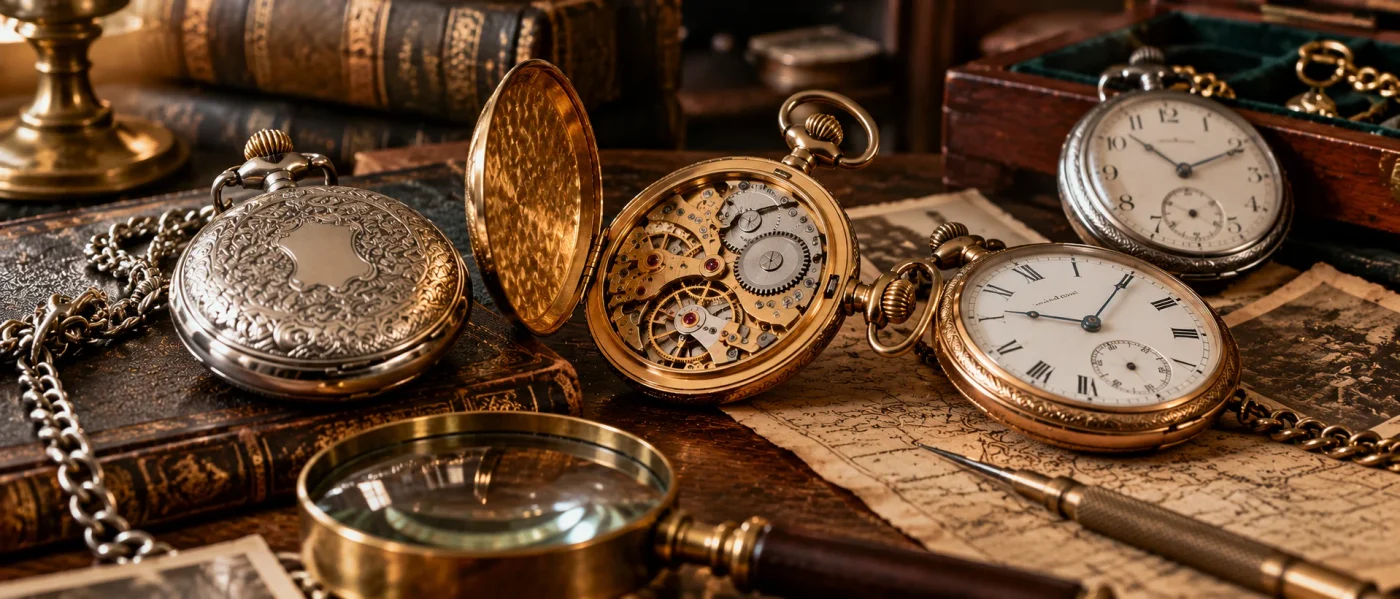
There is no single characteristic that determines value. Instead, collectors evaluate several elements together. Think of pocket watch valuation as a puzzle: each clue changes the overall picture.
1. The maker and movement
The movement is the mechanical mechanism responsible for keeping time, and it is one of the first places to investigate. Open the appropriate rear cover and you may find a manufacturer’s name, serial number, jewel count, grade number or other engravings.
A recognised maker can increase collector interest, but the name alone is not enough. Many manufacturers produced movements at several quality levels. A basic movement and a highly adjusted precision movement from the same manufacturer can therefore command very different prices.
Look for information such as jewel count, grade, adjustments and movement serial number. On certain American watches, movement serial numbers can also help identify an approximate manufacturing period.
2. Case material
The material surrounding the movement can contribute significantly to value. Solid gold naturally has intrinsic metal value, while sterling silver is also desirable. However, gold-filled, rolled-gold and gold-plated cases should not be confused with solid gold.
This distinction matters enormously. A watch can look convincingly gold while containing only a relatively thin layer of gold over another metal.
For readers particularly interested in precious-metal designs, our Gold Pocket Watch collection also shows how the warm gold aesthetic continues to be used in contemporary pocket-watch design.
3. Rarity
Rarity is more complicated than simply asking how many watches were manufactured. A watch becomes especially interesting when scarcity intersects with demand. A rare watch nobody wants is not automatically expensive.
Collectors may pay particular attention to unusual movement grades, limited-production variants, military or railway associations, uncommon dial configurations, complications, special cases or examples with documented histories.
4. Condition
Condition affects both usability and collectability. Collectors typically inspect the movement, dial, hands, crystal, case, crown, bow and hinges. A functioning watch is generally easier to sell than an equivalent broken example, but whether it currently ticks is not the only consideration.
A watch that runs but has been badly modified may be less desirable than a non-running but highly original example that simply requires professional servicing.
5. Originality
This factor is frequently underestimated. Antique watches have often been repaired over many decades. Crystals break, hands disappear, movements are recased and dials are refinished.
Some replacement parts are unavoidable, but serious collectors often place a premium on original components and historically correct combinations. A beautiful restoration is therefore not automatically worth more than an untouched watch showing honest signs of age.
6. Complications
A standard pocket watch displays the time. More sophisticated examples can include chronographs, calendars or striking mechanisms such as repeaters. These mechanisms require considerably greater watchmaking skill and can materially influence desirability.
Complication does not guarantee a high valuation, but an unusual mechanical function from a respected maker can transform the collector profile of a watch.
7. Provenance
Original boxes, receipts, service records, military documentation or a reliably documented ownership history can make a watch more compelling. Provenance becomes particularly important when it connects the watch to a specific historical context.
Family stories are fascinating, but collectors normally distinguish between a story and documented provenance. If your grandfather told you that a watch belonged to his grandfather, preserve that information — but documents, photographs and records provide stronger evidence.
Pocket watch value comparison: what should you expect?
It is tempting to search for a simple price chart, but pocket-watch values cannot be reduced to one figure. Current UK auction guidance illustrates the enormous spread: relatively ordinary base-metal examples may sell for modest sums, while precious-metal and prestigious-maker watches can reach hundreds or thousands of pounds. Exceptional pieces can move far beyond ordinary ranges.
| Type | Potential value influence | What matters most |
|---|---|---|
| Base-metal pocket watch | Usually lower unless rare | Maker, movement and rarity |
| Silver pocket watch | Often collectible | Hallmarks, age, maker and condition |
| Gold-filled pocket watch | Varies considerably | Movement quality rather than gold appearance |
| Solid-gold pocket watch | Higher intrinsic baseline | Gold purity, case weight, movement and maker |
| Railway / high-grade watch | Can attract specialist collectors | Grade, specification, originality |
| Complicated or prestigious watch | Potentially very high | Maker, rarity, complication and provenance |
💡 Important: online asking prices are not reliable valuations. A seller can list a watch at £2,000 without ever finding a buyer. When researching your own piece, completed auction results and actual sold prices are far more informative than unsold advertisements.
Are gold and silver pocket watches valuable?
Precious metal can create a meaningful baseline value, but it is important to establish exactly what you have before making assumptions.
Gold pocket watches
A genuine solid-gold case can be valuable even before the movement is considered because the case contains precious metal. British pieces may carry hallmarks identifying the gold standard and assay office, while other countries use different marking systems.
Common British gold finenesses include 9ct and 18ct, although other standards exist. Do not confuse marks indicating solid gold with terms such as gold filled, rolled gold or gold plate.
Even with solid gold, simply weighing the complete watch and multiplying the result by the gold price is incorrect. The movement, crystal and other components are not gold. A professional should determine the relevant case weight if intrinsic metal value needs to be calculated accurately.
Silver pocket watches
Silver pocket watches occupy an interesting position because they combine precious-metal value with historical and mechanical appeal. British sterling-silver cases can be particularly useful for identification because their hallmarks may reveal metal standard, assay office and date information.
If silver is the aesthetic you prefer rather than something you are trying to appraise, you can explore our Silver Pocket Watch collection, where the traditional cool-metal appearance remains central to the design.
⚠️ Never polish first and research later.
If you discover a heavily tarnished silver watch, resist the temptation to aggressively polish it. Patina and original surface condition can matter to collectors, while abrasive polishing can soften engravings and remove material permanently.
How can I tell if my pocket watch is valuable?
If you have an unknown watch in front of you, work systematically rather than guessing from its appearance. The objective is to build an identification profile before attempting a valuation.
Step 1: examine the dial
Write down every visible word and inspect the dial carefully. Look at the numerals, subsidiary seconds display, hands and overall condition. Hairline cracks, chips and obvious restoration should be recorded rather than immediately repaired.
Remember that a name on the dial does not always identify the actual movement manufacturer. Retailers sometimes placed their own names on watches made by another company.
Step 2: inspect the case markings
Look inside the rear cover for hallmarks, purity marks, case-maker marks and serial numbers. On a British precious-metal case, a group of hallmarks can reveal considerably more than the colour of the metal alone.
A magnifying glass and angled light are useful because old marks can be extremely small.
Step 3: inspect the movement — but only if it opens safely
This is often where the most valuable information is located. Record the manufacturer, serial number, grade, jewel count and adjustment markings.
Do not force a stubborn case. Some pocket watches open with a hinged cover, others have screw backs, and certain constructions require specific tools. Scratching a valuable case to obtain a serial number defeats the purpose of investigating it.
Step 4: photograph everything
Take clear photographs of the front, back, dial, hallmarks and movement. Good photographs allow you to compare markings without repeatedly handling the watch and are extremely useful if you later contact an auction house or watch specialist.
Step 5: research actual comparable sales
Once you know what the watch is, search for examples sharing the same maker, similar movement grade, case material and condition. Comparing a basic silver Waltham to an exceptional solid-gold Waltham simply because the dial bears the same brand is unlikely to produce a meaningful estimate.
🎥 Video: how to identify and value a pocket watch
Seeing a watch opened and inspected can make movement identification, case markings and the difference between solid gold and gold-filled cases much easier to understand. The following detailed guide from Pocket Watch Time covers identification, rarity, case material and valuation:
💡 Practical tip: pause the video while inspecting your own watch and write down each identifier separately. Treat the movement and case as two distinct components until you have established what each one is.
Which pocket watch makers can be valuable?
Maker reputation can have a major influence on value, but there is an important nuance: you cannot accurately value a pocket watch from the brand alone.
Names encountered by collectors include historic American manufacturers such as Waltham, Elgin, Hamilton and Illinois, alongside Swiss and European makers such as Omega, Longines, IWC, Patek Philippe and Breguet. British watches can involve a more complex relationship between movement makers, retailers and case makers.
A prestigious signature deserves investigation, but authenticity, movement grade and originality still need to be established. Similarly, watches from large manufacturers should not automatically be dismissed. Companies such as Waltham, Elgin and Hamilton produced movements across multiple grades, including technically impressive examples that remain desirable among specialist collectors.
Why the movement grade matters
Imagine two watches made by the same company. One contains a relatively simple low-jewel movement intended for the mass market. The other contains a finely finished, high-jewel movement adjusted for accuracy in several positions. The logo might be identical, yet the collector demand can be completely different.
That is why “What brand is it?” should be followed by “Which movement is inside it?”
Does an old pocket watch become more valuable simply because it is old?
No. This is one of the biggest misconceptions surrounding antique watches.
Age can contribute to rarity and historical interest, but only when combined with other desirable characteristics. A nineteenth-century watch produced in huge quantities may remain affordable, whereas a younger but much rarer watch with an important movement could be significantly more valuable.
Consider age as context rather than a price tag. It helps explain how a watch was manufactured, how it was used and where it belongs historically. It does not establish value by itself.
Why very early watches can be different
Earlier pocket watches were generally produced in much smaller numbers and often involved extensive hand finishing. Surviving examples from the seventeenth or eighteenth century can therefore attract specialist attention, especially when complete and original.
However, age introduces additional questions. Has the movement been recased? Is the dial original? Are the hands appropriate? Has the movement been heavily altered during centuries of repairs?
An old date can make these questions more important, not less important.
How much does condition affect pocket watch value?
Condition is crucial, but “good condition” does not simply mean “looks shiny”. Collectors often distinguish between cosmetic appearance, mechanical health and originality.
| Area | Positive signs | Warning signs |
|---|---|---|
| Movement | Clean, complete, correctly serviced | Rust, missing parts, crude repairs |
| Dial | Original surface, clear printing | Major chips, poor refinishing |
| Case | Sharp engraving, good hinges | Deep dents, excessive polishing |
| Originality | Period-correct components | Incorrect hands, dial or replacement case |
One subtle point deserves emphasis: restoration is not always value creation. Repainting an original dial or aggressively refinishing an antique case may make a watch look newer while making it less appealing to collectors.
If you suspect you have an important watch, identification should therefore come before restoration.
7 common mistakes when trying to value an old pocket watch
❌ Mistake 1: assuming gold colour means solid gold
Gold-filled and plated cases can look remarkably convincing. Always investigate the actual markings before assigning precious-metal value.
❌ Mistake 2: assuming every antique pocket watch is expensive
Millions of pocket watches were manufactured. Some remain common today despite their age. Scarcity and desirability matter far more than age alone.
❌ Mistake 3: using an online asking price as proof of value
A listed price tells you what a seller wants. A completed sale tells you what somebody actually paid. The distinction is fundamental when researching collectibles.
❌ Mistake 4: cleaning the watch before identifying it
Abrasive polishing can permanently alter a case. Opening the movement unnecessarily can introduce dust or cause accidental damage. Research first.
❌ Mistake 5: only researching the name on the dial
The dial signature may identify a retailer rather than the manufacturer. Movement markings can tell a very different story.
❌ Mistake 6: assuming a non-running watch is worthless
A rare movement does not become historically insignificant because its mainspring has failed. Repair costs affect market value, but rarity and collectability remain relevant.
❌ Mistake 7: replacing original components unnecessarily
A modern replacement dial may look immaculate but reduce historical originality. When preservation matters, consult a watchmaker familiar with antique pieces rather than automatically restoring everything to an “as new” appearance.
Are pocket watches still worth buying today?
Value does not have to mean resale value. Pocket watches remain unusual because they occupy several worlds simultaneously: mechanical object, historical artefact, collectible and fashion accessory.
A wristwatch is designed to remain visible and immediately accessible. A pocket watch creates a different ritual. Taking it from a waistcoat or trouser pocket, opening the case and reading the dial turns checking the time into a deliberate gesture.
This is one reason pocket watches continue to appear at weddings, formal occasions and vintage-inspired events. They work particularly well with three-piece suits, waistcoats and traditional tailoring, where the chain itself becomes part of the outfit.
🎩 Style advice: the chain matters
If you intend to wear a pocket watch rather than keep it purely as a collectible, avoid treating the chain as an afterthought. The watch, chain, waistcoat and other metal accessories should look intentional together.
A silver-toned watch can work naturally with cooler grey, navy and black tailoring, while warm gold tones pair particularly well with brown, cream, burgundy and traditional tweed. These are not rigid rules — contrast can work beautifully — but repeating a metal tone elsewhere in an outfit usually creates a more coherent result.
For formal events, simplicity often works better than combining an ornate watch, elaborate chain, patterned waistcoat and numerous other accessories simultaneously. Let the pocket watch become the focal detail.
🔍 Pocket watch valuation checklist
Before asking a specialist to value your watch, collect as much information as you safely can. A useful inspection should answer the following questions:
- ☐ What name appears on the dial?
- ☐ What manufacturer is engraved on the movement?
- ☐ What is the movement serial number?
- ☐ Is a movement grade shown?
- ☐ Is the jewel count marked?
- ☐ Are adjustment markings present?
- ☐ What markings appear inside the case?
- ☐ Is the case solid gold, silver, gold-filled or base metal?
- ☐ Are British hallmarks present?
- ☐ Does the watch currently run?
- ☐ Is the dial original and reasonably intact?
- ☐ Are the hands and crown likely to be original?
- ☐ Are there dents or excessive case wear?
- ☐ Does the watch have a chain, box or original paperwork?
- ☐ Is there documented family, military or railway provenance?
💡 A useful rule:
Do not ask “How old is my pocket watch?” and stop there. Ask “Who made the movement, what grade is it, what is the case made from, how original is it and how does its condition compare with examples that have actually sold?” Those questions bring you much closer to a realistic valuation.
Should you sell, restore or keep an inherited pocket watch?
If the watch has sentimental importance, monetary value is only one part of the decision. An inherited watch worth £150 may mean considerably more to a family than its auction price suggests. Conversely, discovering that an inherited piece is genuinely valuable may affect how you insure, store or service it.
If you are considering restoration, obtain an identification first and ask the watchmaker to explain exactly what will be replaced. For potentially collectible watches, conservation and sympathetic servicing are usually more appropriate goals than making the watch appear brand new.
If you intend to sell, consider obtaining more than one opinion for anything potentially significant. Specialist watch auctioneers may recognise a movement grade or unusual feature that a general antiques buyer could overlook.
Frequently asked questions about pocket watch value
Are pocket watches worth anything today?
Yes. Pocket watches can still have meaningful value today, but the amount depends on the individual watch. Maker, movement quality, rarity, precious-metal content, condition, originality and provenance all influence demand. Common base-metal watches can be inexpensive, whereas desirable gold watches, rare movement grades and prestigious makers can command substantially higher prices.
How do I know if my pocket watch is valuable?
Start by identifying the movement rather than judging the watch from the outside. Record the maker, movement serial number, jewel count and grade if visible. Then examine the case for precious-metal marks or hallmarks. Finally, assess condition and originality and compare the watch with genuinely similar examples that have recently sold.
Are 100-year-old pocket watches worth money?
They can be, but being 100 years old does not automatically make a pocket watch valuable. Large numbers of pocket watches were manufactured during the late nineteenth and early twentieth centuries. A century-old watch can therefore be common or highly collectible depending on its maker, grade, case, rarity and condition.
How much is an old pocket watch worth in the UK?
There is no reliable single average. Current UK auction guidance shows ordinary examples selling for relatively modest amounts, silver watches commonly occupying a higher range, and solid-gold or important-maker examples potentially reaching hundreds or thousands of pounds. Particularly rare or prestigious watches can exceed ordinary ranges by a substantial margin.
Are gold pocket watches worth more?
A solid-gold pocket watch has intrinsic precious-metal value, which creates a stronger baseline than a comparable base-metal watch. However, the final value still depends on gold purity and case weight as well as the movement, maker, condition and rarity. Gold-filled or plated cases should not be valued as solid gold.
Are silver pocket watches valuable?
Yes, antique silver pocket watches can be collectible, particularly when they combine a desirable movement with an original hallmarked case. British hallmarks are especially useful because they can provide information about the silver standard, assay office and date of the case.
What pocket watch brands are worth money?
Collectors investigate watches from many makers, including Waltham, Elgin, Hamilton, Illinois, Omega, Longines, IWC, Patek Philippe and Breguet. However, brand alone does not establish value. Movement grade, rarity, case material, originality and condition must also be considered.
Is a pocket watch worth more if it still works?
Generally, a functioning watch is easier to sell than an otherwise identical non-working example. However, a rare non-running movement can still be valuable. Collectors may prefer an original watch requiring sympathetic servicing over a working example that has undergone extensive incorrect restoration.
Should I clean an old pocket watch before selling it?
Usually, you should avoid aggressive cleaning until the watch has been identified. Polishing can remove patina, soften engraving and alter the original surface. Mechanical cleaning should be performed by a competent watchmaker because antique movements can be delicate and replacement parts may be difficult to obtain.
Where is the serial number on a pocket watch?
Many pocket watches have numbers inside the case and another serial number on the movement. These numbers do not necessarily mean the same thing. For many American watches, the movement serial number is particularly useful for identifying the manufacturer, grade and approximate production period.
Does engraving reduce the value of a pocket watch?
It depends. Generic initials can reduce demand among some buyers, but historically significant or documented engraving can add provenance. An inscription linked to a known military service record, railway employee or documented owner may be considerably more interesting than an anonymous monogram.
Are pocket watches a good investment?
Some rare and desirable watches have strong collector markets, but pocket watches should not be assumed to appreciate simply because they are old. Market demand varies considerably between makers and models, while maintenance, authenticity and condition all affect resale value. For most buyers, it makes more sense to choose a pocket watch because of its craftsmanship, history or personal appeal rather than relying solely on future appreciation.
Conclusion: so, are pocket watches worth anything today?
Yes, pocket watches can absolutely be worth something today. But there is no automatic relationship between age and value. A watch that has spent a century in a drawer might be a common mass-produced model, a valuable precious-metal timepiece, a sophisticated high-grade movement or something genuinely rare.
The best clues are usually found by combining maker, movement grade, serial number, jewel count, case material, hallmarks, rarity, originality, condition and provenance. No single one of those factors should normally be considered in isolation.
Perhaps the most important lesson is to identify before you alter. Do not aggressively polish an inherited watch, force open a stubborn case or replace an original dial simply because it looks aged. Photograph it, document its markings and research the movement first.
And monetary value is only one reason pocket watches remain fascinating. Even relatively affordable examples preserve a form of mechanical craftsmanship and personal style that has largely disappeared from everyday timekeeping. Whether yours eventually proves to be worth £50, £500 or considerably more, understanding what it is is the first step towards understanding what it is worth. ⌚
