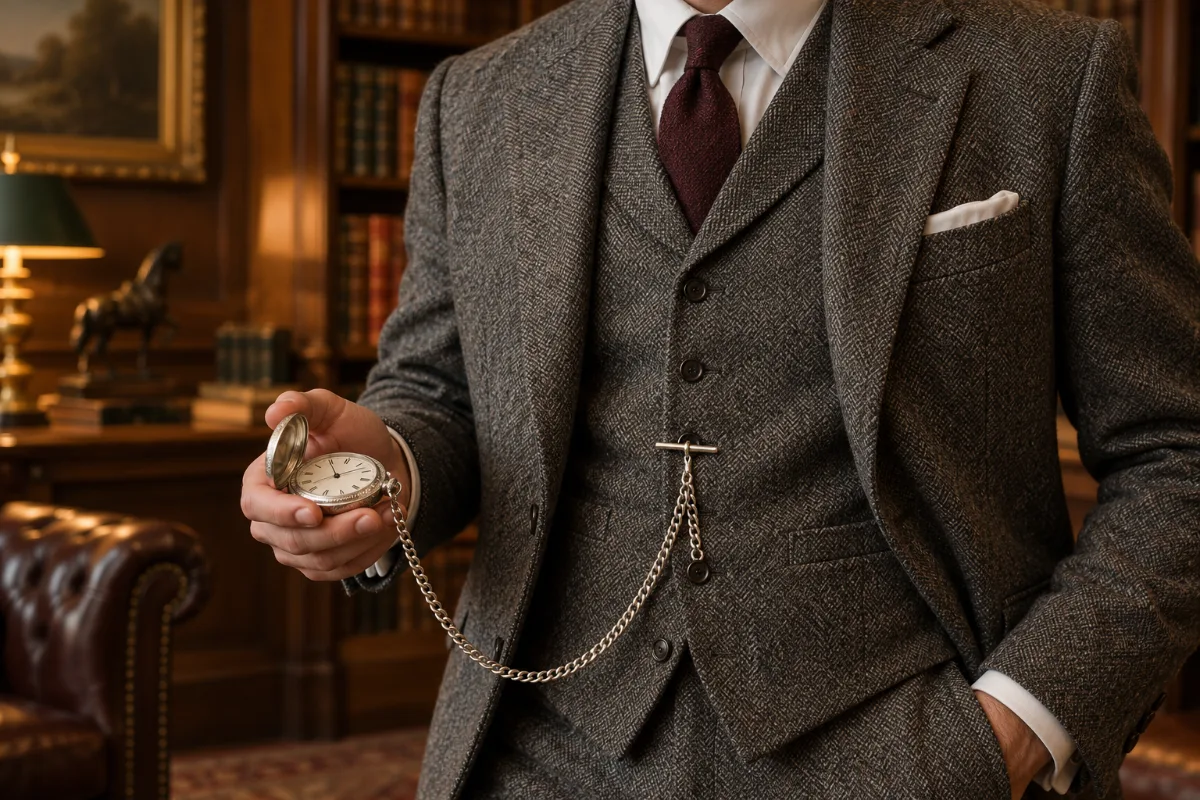
A pocket watch without a chain is a little like a fountain pen without ink: it still works, but something essential is missing. The chain is what keeps a watch safe when you pull it from your pocket, what anchors it to your waistcoat or belt, and, just as importantly, what turns a practical timepiece into a visible piece of style.
Yet when you start looking for a pocket watch chain, the vocabulary can quickly become confusing. Albert, double Albert, T-bar, fob, bolt ring, swivel, belt clip, slide chain: each term describes a slightly different design, a different way of attaching the watch and, often, a different look.
In this guide, we will explain the main types of pocket watch chain, how each one is worn, which lengths and materials make sense, and how to choose a chain that suits both your watch and your wardrobe. Whether you are wearing a three-piece suit to a wedding or carrying a pocket watch with jeans every day, you will find the right option here.
Quick answer: The most popular pocket watch chain is the Albert chain, which attaches to the watch at one end and passes through a waistcoat buttonhole with a T-bar at the other. Without a waistcoat, a belt chain or a short fob chain clipped to a belt loop is the most practical alternative.
“A good chain does two jobs at once: it protects the watch from falls and quietly frames it as the centrepiece of the outfit.”
What is the chain for a pocket watch called?
The general term is simply a watch chain, but several more specific names are used depending on the design. The best known is the Albert chain, a chain with a swivel clip for the watch on one end and a T-bar on the other. You will also hear the terms fob chain, watch guard and vest chain, all of which describe chains designed to secure a pocket watch to clothing.
Strictly speaking, a fob is not the chain itself but the decorative item that hangs from it, such as a seal, a medal, a small charm or a vesta case. Over time, however, “fob chain” has become a common name for short chains and straps used with pocket watches, which is why the terms are often used interchangeably today.
A short history of the pocket watch chain
Chains have accompanied pocket watches for as long as watches have been carried in pockets. Early watches were valuable possessions, and securing them to clothing was the simplest way to prevent loss, damage or theft.
The style most people picture today became fashionable in Victorian Britain. The Albert chain takes its name from Prince Albert, who married Queen Victoria in 1840 and is said to have worn this type of chain. Gentlemen soon adopted the look, threading a T-bar through a waistcoat buttonhole and draping the chain elegantly across the front of the garment.
Albert chains remained an everyday accessory until the early twentieth century. After the First World War, wristwatches became increasingly common and the pocket watch gradually moved from daily essential to classic accessory. You can read more about this evolution in the history of the pocket watch. Today, the chain is enjoying renewed popularity at weddings, formal events and among those who appreciate traditional menswear.
The main types of pocket watch chain
Before choosing a chain, it helps to know the main styles and how each one attaches to your clothes. The table below gives a quick overview.
Chain type
How it attaches
Best worn with
Overall look
Single Albert
Swivel clip on the watch, T-bar through a buttonhole
Waistcoat
Classic and elegant
Double Albert
Central T-bar, watch at one end, fob at the other
Waistcoat
Formal and traditional
T-bar fob chain
Short chain with a T-bar or clip
Waistcoat, jacket buttonhole
Neat and understated
Belt chain
Clip or hook on a belt loop
Trousers, jeans
Casual and practical
Bolt ring chain
Bolt ring to a buttonhole or second pocket
Waistcoat, jacket
Discreet and versatile
Slide chain
Long chain worn around the neck
Dresses, blouses
Decorative and feminine
Leather fob strap
Strap with a clip or loop
Jeans, workwear
Rugged and relaxed
The single Albert chain
The single Albert is the classic pocket watch chain. A swivel clip at one end holds the bow of the watch, while the other end carries a T-bar that passes through a waistcoat buttonhole. The watch then sits in one of the lower waistcoat pockets and the chain forms a gentle curve across the front. Some single Alberts also have a short drop chain on which a small fob can hang.
The double Albert chain
A double Albert consists of two lengths of chain joined at a central T-bar. The watch hangs from one end and sits in one waistcoat pocket, while the other end carries a fob, a seal, a pocket knife or a small vesta case in the opposite pocket. The result is a symmetrical, very formal look that is particularly impressive at weddings and black-tie events.
The T-bar fob chain
A T-bar fob chain is a shorter, simpler version of the Albert. It usually consists of a single length of chain with a clip for the watch and a T-bar to secure it. It is ideal if you want a traditional look without a long chain across your waistcoat.
The belt chain
A belt chain is designed for those who do not wear a waistcoat. One end clips onto the watch, while the other attaches to a belt loop with a hook, clip or bar. The watch then sits in the front trouser pocket or a jeans watch pocket. This is the most practical option for everyday use.
The bolt ring chain
Bolt ring chains use a small spring-loaded ring instead of a T-bar. The ring can be attached to a buttonhole, a belt loop or a second pocket. They are discreet, versatile and easy to fasten, which makes them a good choice for beginners.
The slide chain
Historically popular with women, the slide chain is a long chain worn around the neck, with a decorative slide that adjusts the length. Today, many people wear pocket watches as pendants in a similar way, often on a long necklace-style chain.
The leather fob strap
A leather fob strap replaces metal links with a short strip of leather, often with a metal clip. It suits rugged, vintage and workwear styles particularly well and is less likely to scratch the watch case.
The anatomy of a pocket watch chain
Whichever style you choose, most watch chains are made up of the same small components. Knowing what they are makes it much easier to compare chains and to spot a quality piece.
The swivel clip (dog clip): a sprung clip that attaches to the bow of the watch. Its swivel allows the watch to turn freely without twisting the chain.
The T-bar: a short bar that passes through a buttonhole and anchors the chain to the waistcoat.
The bolt ring: a small spring ring used to attach the chain to a buttonhole, belt loop or fob.
The drop: a short length of chain that hangs down from the main chain and carries a fob or the T-bar.
The fob: a decorative item such as a seal, medal, coin or charm that adds personality to the chain.
On a well-made chain, these components should feel solid. The clip should close firmly, the swivel should turn smoothly, and the links should lie flat without kinks or sharp edges that could scratch your watch.
Which chain suits your pocket watch?
The right chain depends partly on the watch itself. A heavier watch with a full metal case needs a sturdier chain and a strong clip, while a slim, lightweight watch looks best on finer links that do not overwhelm it.
The case style also plays a role. Hunter and half-hunter watches, which have a protective lid over the dial, are opened frequently, so a chain with a good swivel makes it easier to turn the watch in your hand. Open-face watches, on the other hand, are read instantly and pair well with simpler, shorter chains.
Finally, consider how often you will wear the watch. For daily use, prioritise durability and a secure attachment. For special occasions, you can choose a more decorative chain, such as a double Albert or a chain with a fob.
How long should a pocket watch chain be?
Length is one of the most important and most overlooked details. A chain that is too short pulls the watch out of the pocket, while one that is too long hangs untidily and can catch on things.
Chain type
Typical length
Tip
Single Albert
Around 30 to 40 cm (12 to 16 inches)
Should form a gentle curve, not a tight line
Double Albert
Two lengths, often similar to a single Albert each
Check that both pockets can be reached comfortably
T-bar fob chain
Shorter, often under 30 cm
Ideal for slim waistcoats
Belt chain
Often similar to or slightly longer than an Albert
Allow enough length to read the watch without unclipping it
Slide or necklace chain
Long, worn around the neck
Choose a length that lets the watch sit at mid-chest
The easiest way to check the length is to put the watch in the pocket you plan to use, attach the chain and let it hang naturally. You should be able to take the watch out and read it comfortably without the chain pulling tight.
Which material should you choose?
Pocket watch chains are made in a wide variety of materials, from solid gold to stainless steel. The best choice depends on your budget, your watch and how often you plan to wear the chain.
Material
Durability
Look
Good to know
Solid gold
Very good
Warm, luxurious
9ct is the most common fineness for antique British chains
Sterling silver
Good
Bright, classic
Look for hallmarks such as the lion passant
Rolled gold or gold-filled
Good
Gold look at a lower price
Not solid gold, but more durable than simple plating
Stainless steel
Excellent
Modern, cool-toned
Robust and easy to care for
Plated metal
Moderate
Varied finishes
Affordable, but the finish can wear over time
Leather
Good
Rugged, vintage
Softer on the watch case
As a general rule, match the chain to the metal of your watch case: a silver chain with a silver watch, a gold chain with a gold watch. Mixing metals can work in a deliberately vintage or eclectic outfit, but a matching chain always looks more polished. For a traditional look, an Albert chain in a tone that matches your watch is a reliable starting point.
How to wear a pocket watch chain
The way you wear your chain depends mainly on your outfit. Here are the most common options, from the most formal to the most casual.
With a waistcoat
This is the traditional way. Place the watch in one of the lower waistcoat pockets, then pass the T-bar through a buttonhole, usually the third or fourth from the top, so that the chain forms an elegant curve. With a double Albert, the second end goes into the opposite pocket, often carrying a fob.
With a suit but no waistcoat
If you are wearing a suit jacket without a waistcoat, you can secure a short chain to a jacket buttonhole or belt loop and keep the watch in your trouser pocket. Keep the chain short and discreet so that it does not hang below the jacket.
With trousers or jeans
For everyday wear, a belt chain is the most practical choice. Clip the chain to a belt loop and slip the watch into your front pocket or the small watch pocket found on many jeans. A leather fob strap gives the look a relaxed, vintage character.
As a necklace
Many people, especially women, wear a pocket watch as a pendant. A long chain worn around the neck lets the watch sit at chest height and turns it into a striking piece of jewellery.
“The chain should always look intentional. If it hangs too low, twists or pulls the pocket open, it is either the wrong length or attached in the wrong place.”
Matching your chain to the occasion
A pocket watch chain can be formal or casual depending on its style, length and material. The table below suggests combinations for different occasions.
Occasion
Recommended chain
Outfit
Finishing touch
Wedding (groom or groomsman)
Double Albert or single Albert
Three-piece suit
Fob or engraved charm
Black-tie event
Fine single Albert in gold or silver
Dinner suit with waistcoat
Keep it minimal
Office
Short T-bar or bolt ring chain
Suit or blazer
Discreet, matching metal
Smart casual
Belt chain
Chinos and shirt
Leather or slim metal chain
Everyday
Belt chain or leather fob
Jeans and jacket
Practical and durable
Vintage or steampunk style
Chunky Albert or fancy link chain
Waistcoat, tweed
Decorative fob
For weddings in particular, matching chains for the groom and groomsmen create a very elegant result in photographs and make a thoughtful, lasting gift.
Watch chain accessories and fobs
A fob is the easiest way to personalise a watch chain. Traditionally, fobs included wax seals, medals, coins, small pocket knives and vesta cases for matches. Today, you can choose from charms, engraved discs, initials or small decorative pendants.
If you wear a double Albert, the fob usually sits in the pocket opposite the watch. On a single Albert, it can hang from the short drop near the T-bar. You will find a selection of chains, cases and other pocket watch accessories in our shop to complete your look.
How to care for a pocket watch chain
A good chain can last for generations if it is looked after properly. Fortunately, care is simple.
Wipe it regularly with a soft, dry cloth to remove skin oils and dust.
Clean solid metals gently with lukewarm water and a little mild soap, then dry thoroughly. Avoid soaking plated chains.
Polish sparingly. Silver can be refreshed with a silver cloth, but avoid abrasive pastes, especially on antique or plated chains.
Check the clasp and swivel from time to time. A worn spring could let your watch slip free.
Store the chain separately in a pouch or box so that it does not scratch your watch or become tangled.
Video: pocket watch chain styles and how to wear them
Seeing the different chains worn on a waistcoat makes it much easier to understand how each style looks in practice. The following video presents the main types of watch chain and demonstrates how to wear them.
7 common mistakes when choosing a pocket watch chain
Choosing the wrong length: too short and the watch is pulled out of the pocket, too long and the chain hangs untidily.
Ignoring the weight of the watch: a heavy watch on a fine chain puts unnecessary strain on the links and the clip.
Mixing metals by accident: a gold chain with a silver watch rarely looks deliberate unless the rest of the outfit supports it.
Wearing a waistcoat chain without a waistcoat: a T-bar needs a buttonhole; with jeans or trousers, choose a belt chain instead.
Overloading the chain: several large fobs and charms can make the chain look cluttered and heavy.
Forgetting the clasp: a weak or worn clip is the most common reason pocket watches are dropped.
Assuming gold colour means solid gold: rolled gold and plated chains look similar but are worth far less. Check the markings.
Frequently asked questions about pocket watch chains
What is the chain for a pocket watch called?
It is generally called a watch chain. The most common type is the Albert chain, but you will also hear the terms fob chain, watch guard and vest chain.
What are the different types of watch chains?
The main types are the single Albert, the double Albert, the T-bar fob chain, the belt chain, the bolt ring chain, the slide chain and the leather fob strap. Each attaches to clothing in a slightly different way.
What is the best pocket watch chain?
There is no single best chain. With a waistcoat, a single Albert is the classic choice. Without one, a belt chain is the most practical. For formal occasions, a double Albert creates the most elegant look.
What is a Prince Albert chain?
A Prince Albert chain, or simply Albert chain, is a watch chain with a swivel clip for the watch and a T-bar that passes through a waistcoat buttonhole. It is named after Prince Albert, the husband of Queen Victoria.
How long should a pocket watch chain be?
Most single Albert chains measure roughly 30 to 40 cm. The ideal length lets you take out and read the watch comfortably while the chain forms a gentle curve across the waistcoat.
Can you wear a pocket watch chain without a waistcoat?
Yes. Clip a belt chain to a belt loop and keep the watch in your trouser or jeans pocket, or attach a short chain to a jacket buttonhole.
Which side should a pocket watch chain go on?
There is no strict rule. The watch usually sits in one of the lower waistcoat pockets, with the T-bar through a central buttonhole. Choose the side that feels most natural when you take the watch out.
Is a fob the same as a watch chain?
Not exactly. A fob is traditionally the decorative item hanging from the chain, such as a seal or medal, although short chains and straps are often called fob chains today.
Can women wear a pocket watch chain?
Absolutely. Women can wear a pocket watch with a belt chain or a waistcoat, or as a pendant on a long necklace chain, which has a long tradition in the form of the slide chain.
Do I need a chain for my pocket watch?
A chain is not strictly necessary, but it is strongly recommended. It protects the watch from falls and theft and completes the classic pocket watch look.
Conclusion: choosing the right pocket watch chain
A pocket watch chain is far more than a functional accessory. It secures your watch, frames it elegantly and defines the style of your entire outfit, from the formal elegance of a double Albert to the relaxed character of a leather fob.
To choose well, start with your outfit: an Albert chain for waistcoats, a belt chain for trousers and jeans, and a necklace chain if you prefer to wear your watch as jewellery. Then match the length, weight and metal to your watch.
With the right chain, your pocket watch will be not only safer but also more visible, and a timeless detail that people notice.
We use cookies. Strictly necessary cookies (basket, checkout, security) are always active. With your consent, we may also use optional cookies to improve our shop. You can change your choice at any time via "Cookie settings" at the bottom of every page.